

The Blue Mosque, officially the Sultan Ahmed Mosque or Sultanahmet Camii, stands at the Hippodrome end of Sultanahmet Square, directly facing Hagia Sophia. It is one of the few big-name sights in Istanbul that costs nothing.
This guide covers what we could confirm in November 2026. The mosque does not publish a fixed timetable we could find, so the opening pattern below comes from several independent guides plus the official prayer times.
Yes. There is no admission fee, and a guide updated at the end of October 2026 confirms none has been introduced for foreign visitors. “Skip-the-line Blue Mosque tickets” are really tours. Our tourist scams guide explains how the Sultanahmet touts work.
Non-Muslim visitors use a separate entrance on the south side of the mosque, with barriers and a dress-code sign. The main courtyard gates, including the one facing the Hippodrome, are mainly for worshippers, and the arrangement has shifted over the years, so follow the barriers and the staff. Everyone passes a dress check and security screening.
Queue reports vary a lot: under 15 minutes at quiet times, and 30 to 60 minutes at midday in peak summer. The route through the hall is one-way, and one guide updated in November 2026 reports that you leave by a different exit and cannot go back in, so take your photos before you go through. Allow one to one and a half hours door to door, including the queue.
The mosque is open to visitors every day, usually from about 08:30. The catch is that it closes to visitors around each of the five daily prayers, and prayer times move with the sun, so there is no single set of hours that holds all year. Independent guides report the pattern below.
| When | What to expect |
|---|---|
| Morning | Opens to visitors from about 08:30. This is the quietest hour. |
| Each of the five daily prayers | Closed to visitors, reported from roughly 30 to 45 minutes before the call to prayer until 15 to 30 minutes after. Some guides describe closures of up to 90 minutes. |
| Friday | Closed to visitors through the midday congregational prayer, with reopening reported at about 14:30. |
| Evening | Last entry depends on the season. Guides give anything from about 17:00 in winter to 19:00 in summer, and the sunset prayer can cut it shorter. |
Here is how that works on a real day. The Diyanet (Turkey’s Presidency of Religious Affairs) lists Istanbul prayers on 9 November 2026 at 12:53 (midday), 15:34 (afternoon) and 17:59 (sunset). If the windows above hold, you would have the morning until about 12:10, then a short slot after 13:20 before the afternoon closure starts around 14:50. Check the day’s times on the official Diyanet prayer-times page for Istanbul, and look at the board by the entrance, which is the final word.
If Friday is your only day in Sultanahmet, visit the mosque in the afternoon.
Rules are enforced at the gate.
UK summer holiday kit is the usual problem. Put a light scarf or sarong in your day bag and you can cover up in a minute. Keep your voice down and do not photograph people who are praying. Photography is generally fine without flash. More on etiquette is in our things that surprise visitors to Turkey page.
No. The big restoration ran from 2018 and the mosque reopened on 21 April 2023, according to the state news agency Anadolu Ajansı, which says it shut completely for only about five months of that period. On 27 February 2026 Culture and Tourism Minister Mehmet Nuri Ersoy said the main works were finished, as reported by Türkiye Gazetesi. That covered the six minarets, about 400 tonnes of new lead roofing and more than 22,000 tiles documented and treated.
A few jobs were still open then, including the Hünkar Kasrı (the imperial pavilion) and landscaping. A guide updated on 5 November 2026 reports the scaffolding gone and both courtyards open, with the imperial loge partly closed and the pavilion shut. You should see the whole prayer hall and its domes. Hagia Sophia, by contrast, is mid-restoration.

Sultan Ahmed I started the mosque in 1609, and it was largely complete in 1616, with an opening in 1617 depending on the source. The architect was Sedefkâr Mehmed Ağa. The original complex also had a tomb, a madrasa, a hospital, a soup kitchen and a bazaar. The mosque is part of the “Historic Areas of Istanbul” UNESCO World Heritage Site, inscribed in 1985; see the UNESCO listing or our Istanbul historic areas page.
| Blue Mosque | Hagia Sophia | Süleymaniye | |
|---|---|---|---|
| Built | 1609 to 1616 | 537 | 1550 to 1557 (Sinan) |
| Entry for visitors | Free | €25 (about £21) | Free |
| Minarets | Six | Four | Four |
| Known for | İznik tiles and a perfect skyline | Byzantine dome and gallery mosaics | Calm courtyard, view over the Golden Horn |
If you only have time for one, pick the Blue Mosque for its interior or Hagia Sophia for its history. The Süleymaniye is the quieter option. All three follow the same prayer-time and dress rules.

Everything below is within a short walk.
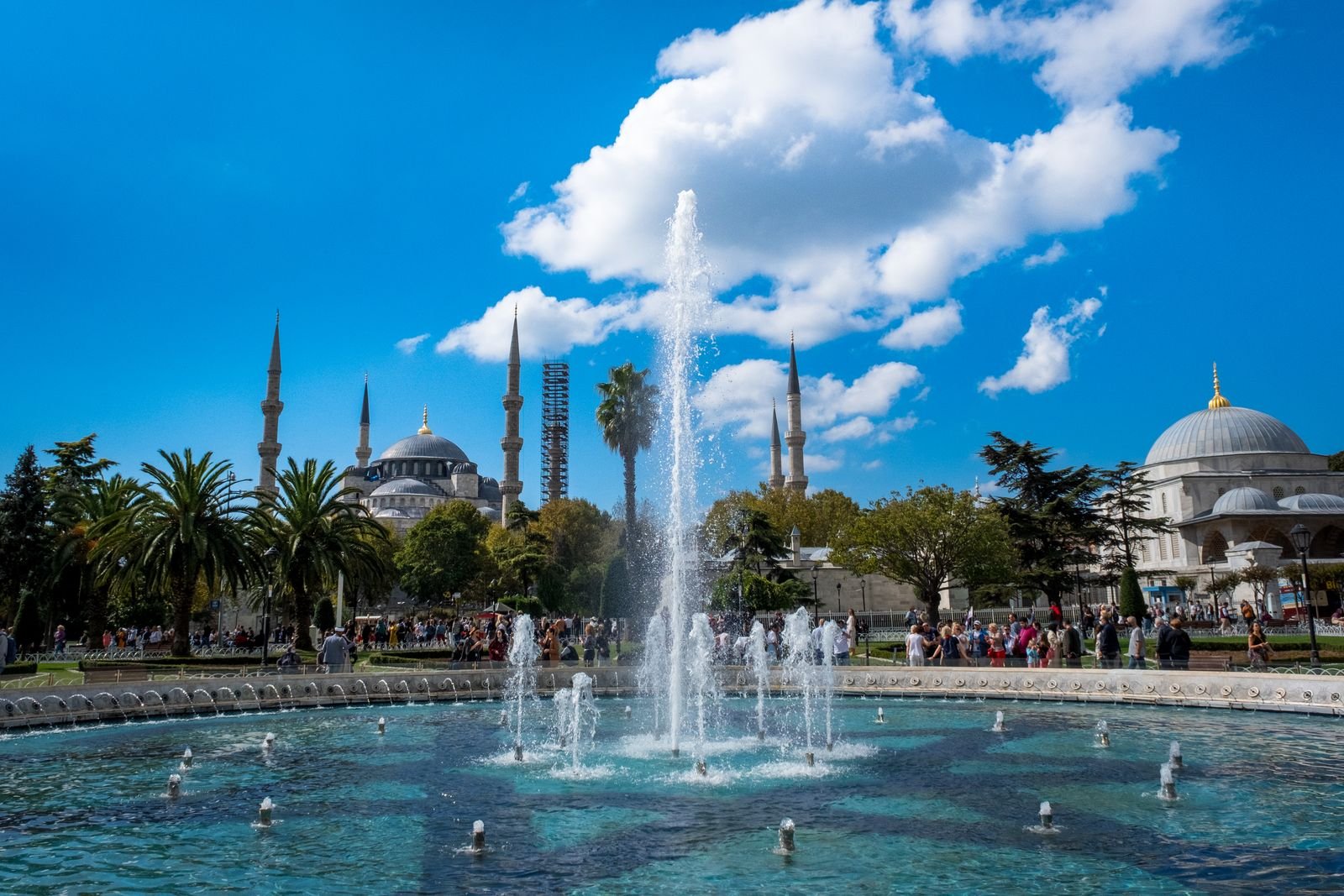
Our things to do in Istanbul and 3 days in Istanbul itinerary show how to space this out with the rest of the city.
Video: Blue Mosque Istanbul: Dress Code, Opening Hours & What to Avoid by WeGuideIstanbul (September 2025). Filmed at the gate. Treat its timings as a guide and check the day’s prayer times.
Take the T1 tram to the Sultanahmet stop. The mosque is a two to three minute walk. A single ride costs ₺46.20 (about 70p) with an Istanbulkart; see our Istanbulkart guide.
Turkey stays on UTC+3 all year, so it is three hours ahead of the UK in winter and two in summer. Our where to stay in Istanbul guide compares areas, and Is Turkey safe covers the FCDO advice.
No. Entry is free for everyone and needs no booking.
Only in the afternoon. The mosque is closed to visitors through the midday congregational prayer and reopens, according to guides, at about 14:30.
Women do. Everyone must cover shoulders and knees. Free scarves are available at the entrance.
No. The major restoration finished in 2023, and small areas such as the imperial pavilion may still be shut.
Yes. One is known for Byzantine mosaics, the other for tiles, and the Blue Mosque is free.
Prices and opening details checked in November 2026. Confirm on the official page before you go.