Try one: short ebru workshops run in Istanbul, and Avanos in Cappadocia has pottery studios where you can use the wheel.
Shopping: buy new, keep receipts, and never buy antiquities, which cannot legally leave Turkey.
Walk into an Ottoman mosque and you are surrounded by crafts: tiles on the walls, calligraphy in the domes, carved wood and gilded panels. Many of those skills are still taught today, passed from master to apprentice in small workshops in Istanbul, Bursa, Kütahya and Gaziantep.
This guide explains the main Turkish crafts, where to see the best historic examples, where you can have a go yourself, and how to shop for the real thing without overpaying or breaking the law.
Turkish crafts at a glance
| Craft | What it is | Where to see or buy | UNESCO |
|---|---|---|---|
| Ebru | Marbled paper made on water | Istanbul studios and workshops | 2014 |
| Çini (İznik and Kütahya) | Hand-painted glazed tiles and ceramics | İznik, Kütahya, Istanbul mosques | 2016 |
| Hüsn-i hat | Calligraphy in Arabic script | Mosques, museums, calligraphers’ studios | 2021 |
| Tezhip | Gold illumination of manuscripts | Museums, art studios | 2023 (joint) |
| Copperware | Hand-hammered and engraved pots, trays, coffee pots | Gaziantep, Grand Bazaar | No |
| Karagöz | Shadow theatre with leather puppets | Bursa, performances in Ramadan | 2009 |
| Meerschaum | Carved pipes from a soft white mineral | Eskişehir | No |
Ebru: painting on water
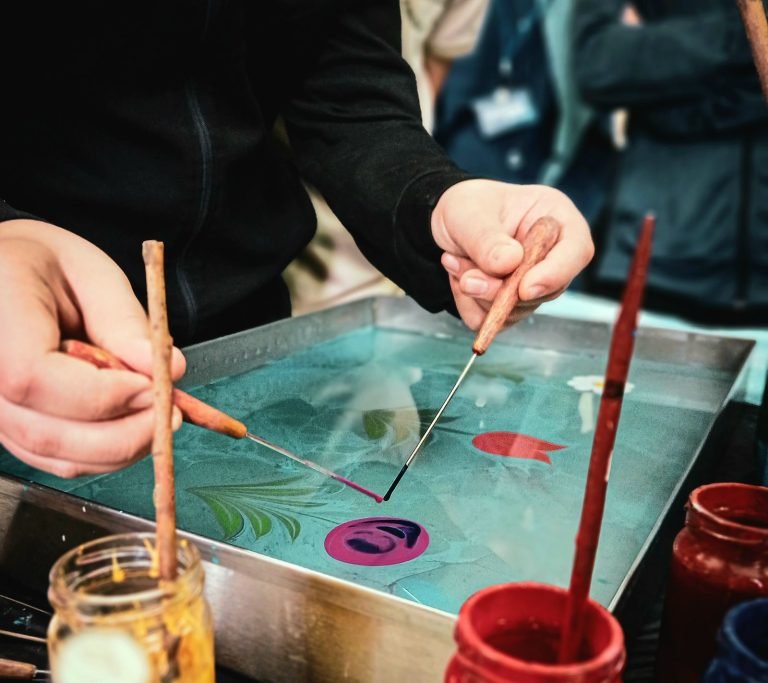
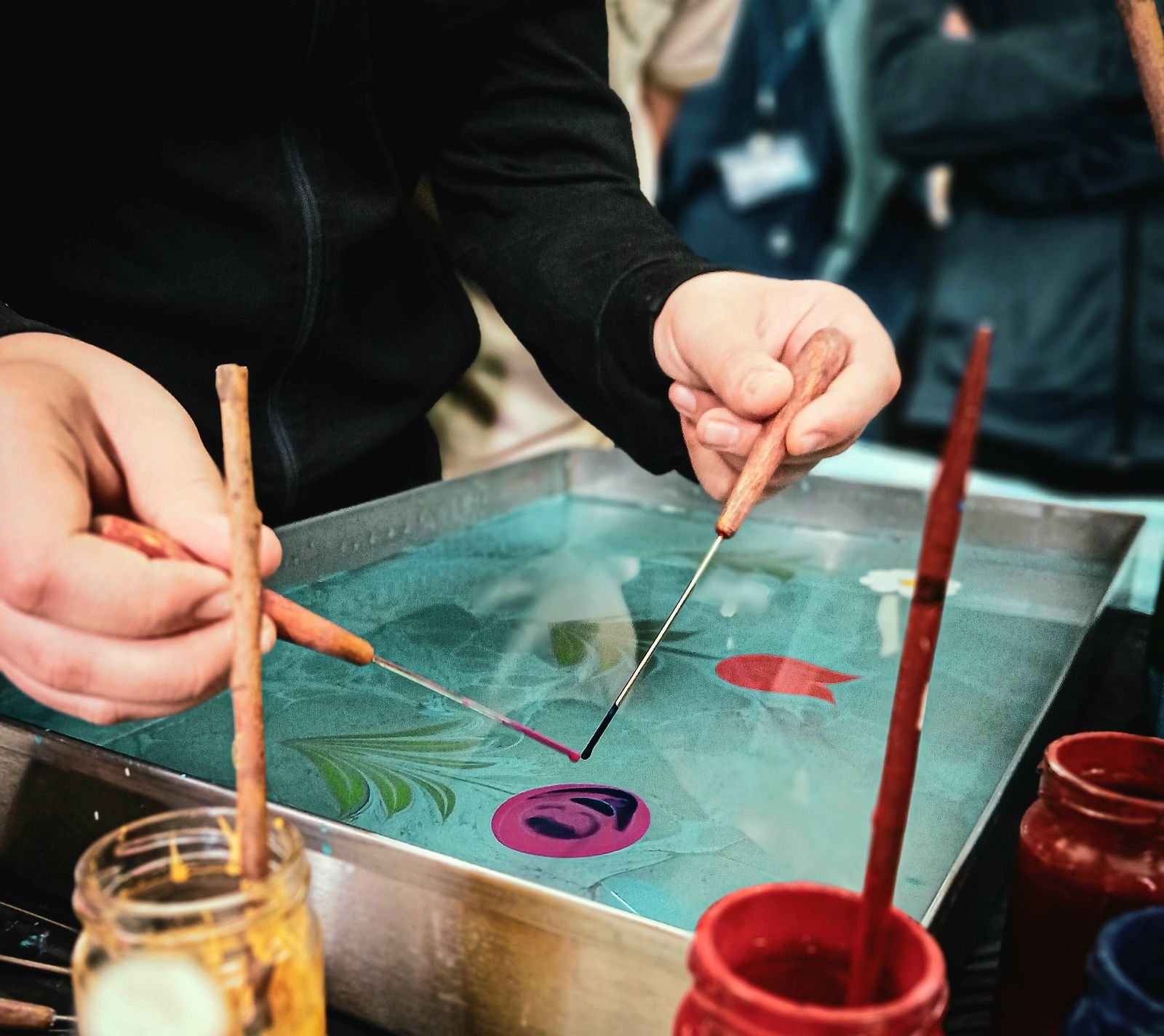
Ebru is the art Europeans call Turkish marbling. The artist fills a shallow tray with a thickened liquid, then sprinkles and brushes natural pigments onto the surface. A few drops of ox gall in each colour help it spread instead of sinking. With a stylus or comb the artist drags the colours into waves, combs or flowers such as tulips and carnations, then lays a sheet of paper on top and lifts the design off in one movement. No two sheets are ever the same.
UNESCO inscribed ebru, the Turkish art of marbling, on its Representative List in 2014.
Art of Ebru, a short English-language film of ebru masters at work (Go Türkiye, the official tourism channel, March 2017). Watch on YouTube.
İznik and Kütahya ceramics
The blue, turquoise and red tiles of Ottoman mosques come from the town of İznik, southeast of Istanbul. Potters there came into their own in the late 15th century. Early pieces were blue and white, influenced by Chinese porcelain; by the mid-16th century turquoise, greens and purple had joined them, and by the late 16th century a vivid red. Quality fell in the 17th century, and production had stopped by 1800.
The craft was revived in the 1990s. The İznik Foundation, opened in 1993, worked with scientists to rediscover the quartz-rich body of the old tiles and opened a tile atelier in 1996. Kütahya, in western Anatolia, is the other great tile town and is still a working ceramics centre. Its Tile Museum, in a 14th and 15th-century building, shows tiles from the 14th century to today alongside the brushes, paints and pattern sheets of the trade.
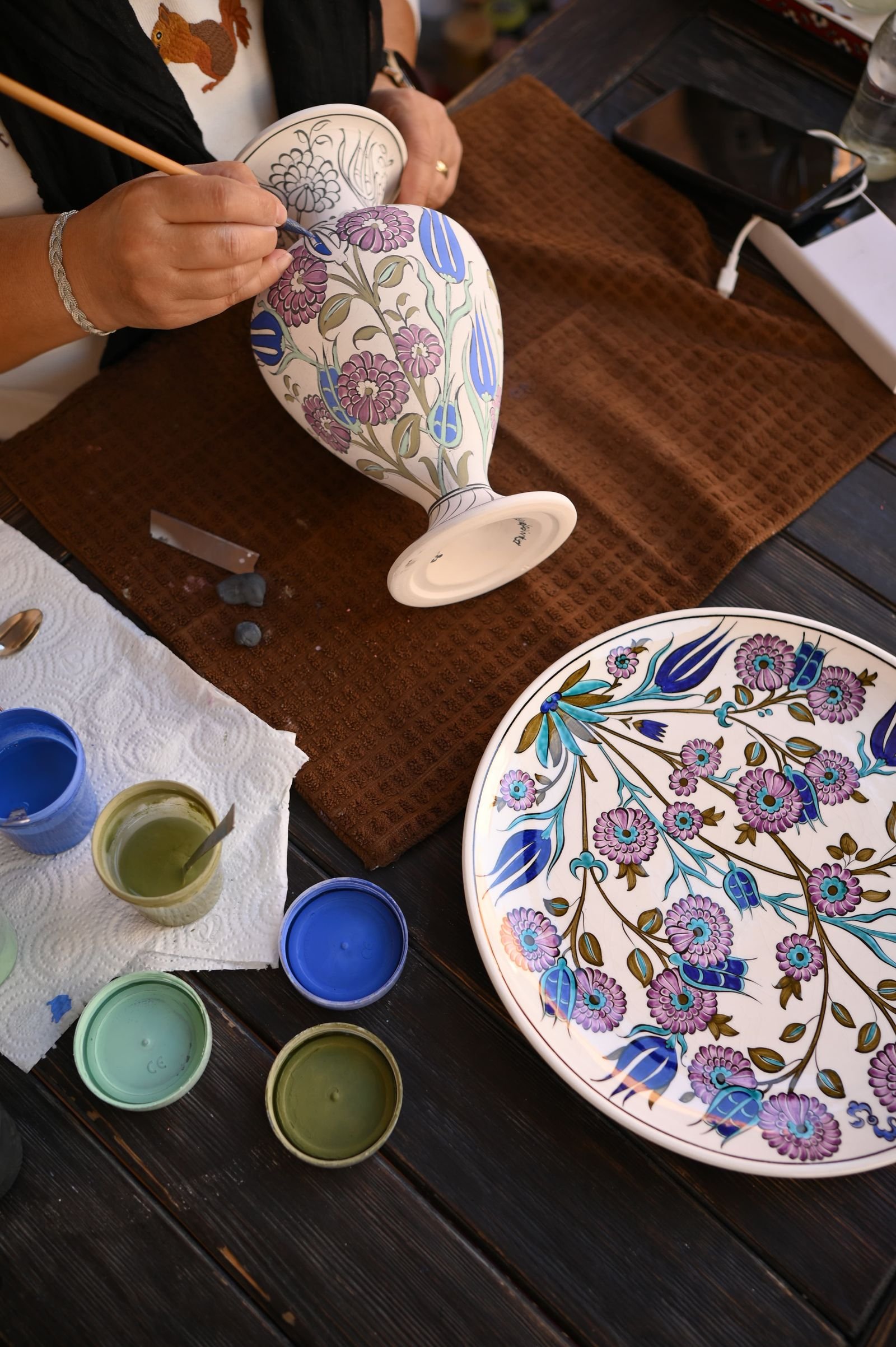
UNESCO inscribed çini-making, the traditional craft of hand-painted tiles and ceramics, in 2016. Designs are pricked through paper, transferred with coal dust, outlined by hand, coloured, glazed and fired.
Where to see the best tiles
- The Harem at Topkapı Palace, lined with İznik tiles.
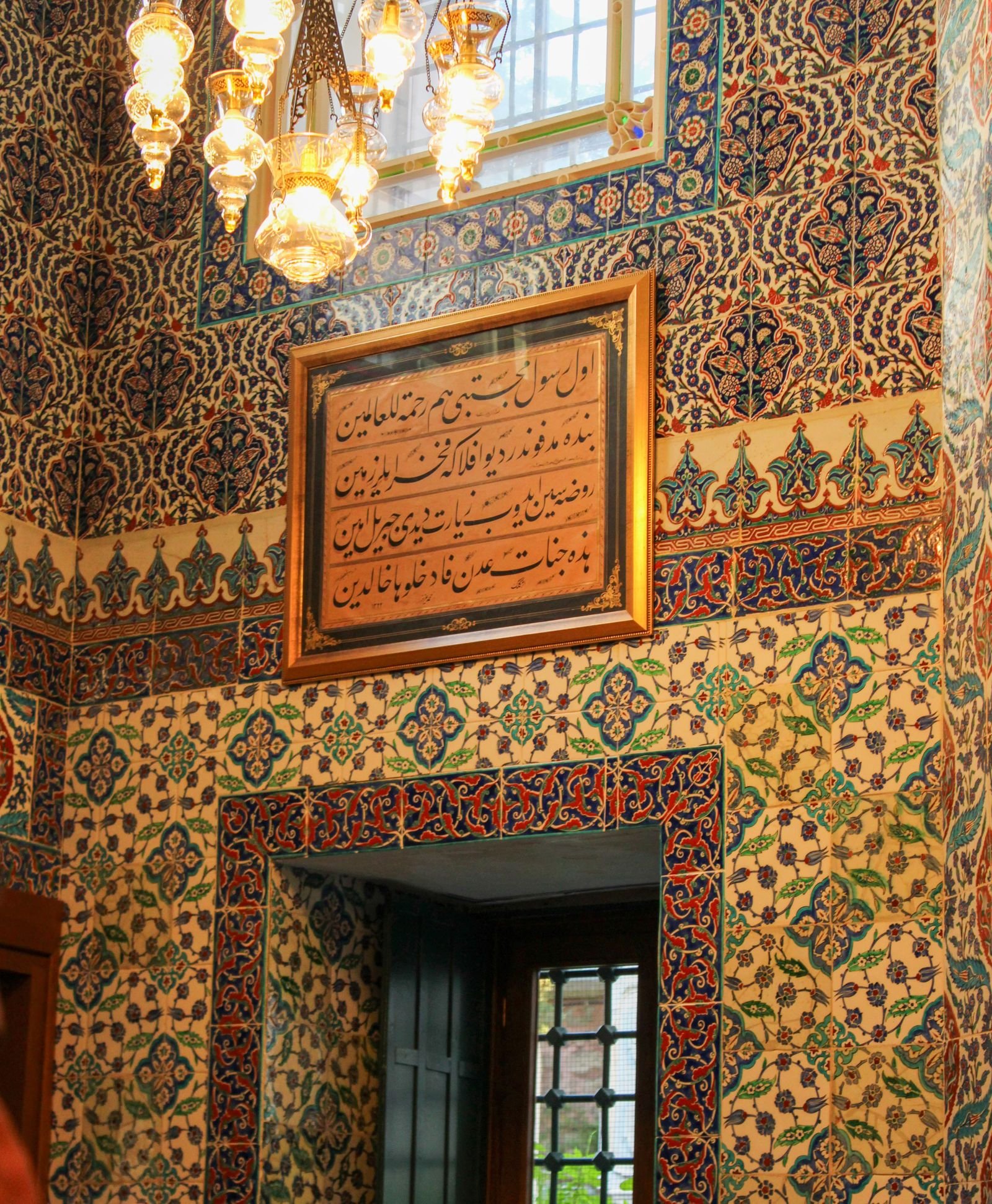
- The Rüstem Pasha Mosque near the Spice Bazaar, built by Mimar Sinan and covered inside with İznik tiles.
- The Green Mosque and Green Tomb in Bursa, for earlier Ottoman tilework.
Why Is Iznik Pottery So Beautiful? The Art of Ottoman Ceramics, a short English explainer on the colours and history of İznik ware (Sotheby’s, April 2026). Watch on YouTube.
Calligraphy and illumination
Hüsn-i hat, “beautiful writing”, is the art of Arabic-script calligraphy as practised in Turkey. Calligraphers, called hattat, write with a trimmed reed pen and soot ink on paper glazed with organic substances, often making their own tools, and learn through long apprenticeships with a master. In Ottoman buildings, calligraphy is the main decoration: giant roundels in the domes, inscriptions over doors and panels on the walls. UNESCO inscribed Hüsn-i Hat in 2021.
Tezhip is the art of illumination that frames calligraphy and manuscripts with gold leaf or gold paint and fine natural pigments. It was inscribed by UNESCO in 2023 as a joint element of Türkiye, Azerbaijan, Iran, Tajikistan and Uzbekistan. UNESCO has also listed the art of miniature (2020) and mother-of-pearl inlay (2023), both shared with neighbouring countries.
Copperware
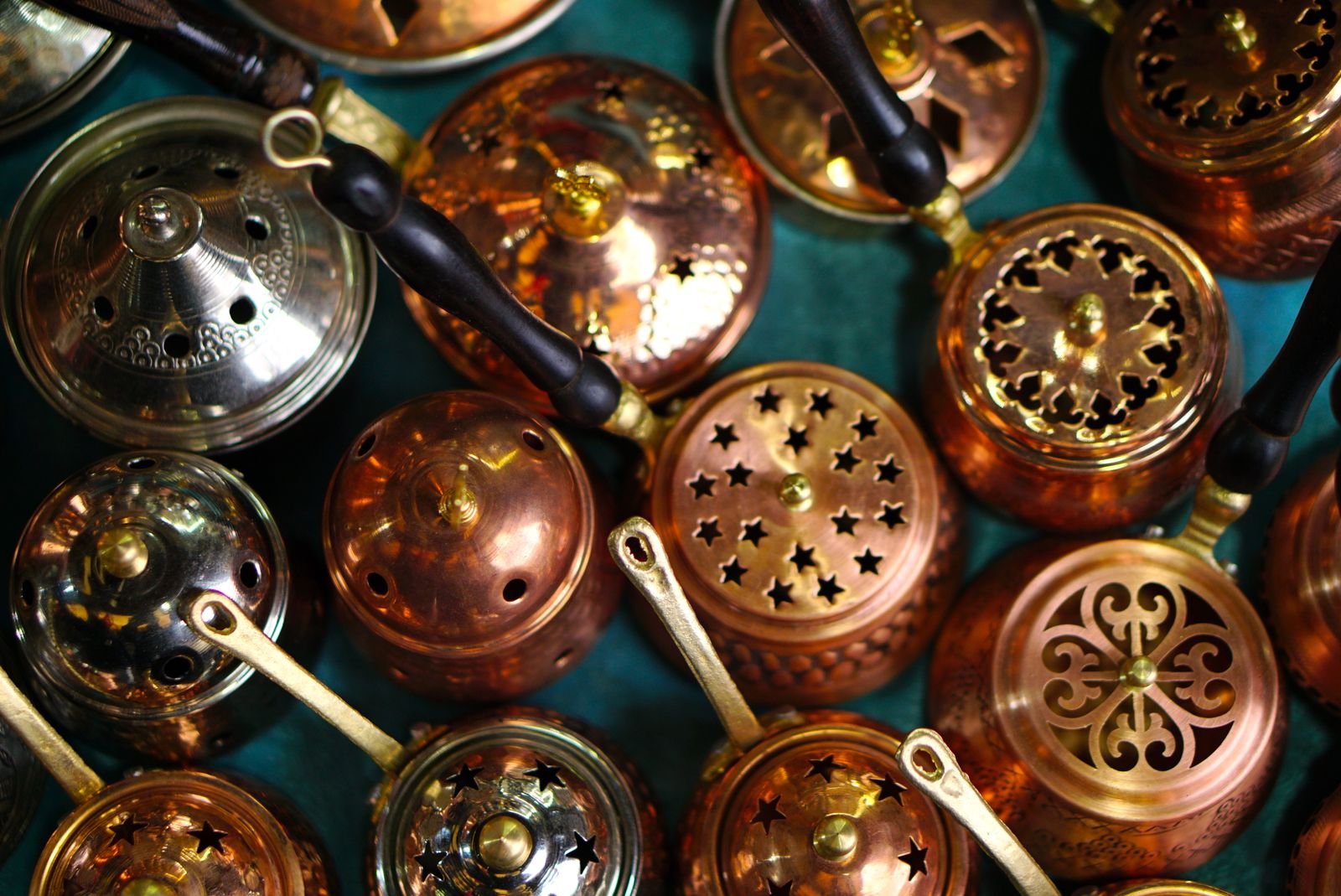
Copper pots, pans and coffee pots were long part of everyday Turkish kitchens. Gaziantep, in the southeast, is the best-known centre: its craftsmen still hammer and engrave patterns by hand in the old copper bazaar, making traditional pans and coffee pots as well as new designs. Today most copper is bought for display, but a hand-made cezve (coffee pot) is still the traditional way to make Turkish coffee.
If you plan to cook in it rather than display it, tell the seller, who can point you to pieces made for kitchen use.
Karagöz shadow puppets
Karagöz is Turkey’s traditional shadow theatre. Translucent figures cut from camel or ox hide and coloured are pressed against a lit cotton screen, while a puppeteer moves them and voices the characters. The two heroes are Karagöz, the plain-spoken everyman, and Hacivat, his more pompous, educated partner; their bickering drives every play. Plays were once staged in coffeehouses and squares, especially during Ramadan and at circumcision feasts. UNESCO inscribed Karagöz in 2009.
Legend places the pair in Bursa, as builders on a mosque for Sultan Orhan who were executed because their joking slowed the work. Treat it as a story, not history. In Bursa you can visit the Karagöz Museum and the symbolic tombs of the two characters. For a quick taste in English, watch TRT World’s report on Karagöz and Hacivat.
Meerschaum from Eskişehir
Meerschaum (lületaşı in Turkish) is a soft, white mineral, a hydrous magnesium silicate, mined underground near Eskişehir in western Anatolia. Despite the old belief, it is not fossilised sea creatures. Light and porous, it acts as a natural filter, and a meerschaum pipe slowly darkens to a rich brown with use. Local carvers turn it into elaborately carved pipes and ornaments. Eskişehir’s Meerschaum Museum, in the Kurşunlu Complex in the old Odunpazarı quarter, displays around 400 pieces by local artisans.
Workshops you can join
- Ebru in Istanbul: several studios in Sultanahmet run short beginner sessions where you make your own marbled sheets to take home. One example is Les Arts Turcs, which lists ebru workshops on its website. Book a day or two ahead and ask how long the session lasts and what it costs.
- Pottery in Avanos: this Cappadocia town on the Kızılırmak (Red River) has made pottery for thousands of years, and many workshops let you try the wheel. See our guide to things to do in Cappadocia.
- Tile painting: ceramic studios in İznik, Kütahya and Bursa often let visitors watch painters at work, and some offer short painting sessions on a plate or tile. Ask locally.
Shopping tips
- Hand-painted or printed? Hand-painted tiles and bowls show small variations in line and colour, and the back is often signed. Perfectly identical pieces at very low prices are usually transfer-printed.
- Where to shop: the Grand Bazaar has every craft under one roof, but prices start high, so compare and bargain politely. In İznik, Kütahya, Gaziantep and Eskişehir you can buy at the source.
- Do not buy antiquities. The UK government’s travel advice for Turkey warns that buying or exporting antiquities is illegal, with fines and prison sentences of 5 to 12 years. Some old items sold legally in markets still cannot be exported, so check before you buy.
- Keep receipts for UK customs and for any guarantee of age or materials.
- Pack ceramics in your hand luggage if they fit, wrapped in clothes. Copper and meerschaum travel well; ask the shop for a box.
For more ideas, see our guide to Istanbul souvenirs.
Frequently asked questions
What is the most famous Turkish craft?
Carpets and kilims are the best known abroad, followed by İznik tiles and ebru marbling. See our guide to Turkish carpets and kilims.
Are İznik tiles still made in İznik?
Yes. The craft died out by 1800 but was revived in the 1990s, and workshops in İznik, Kütahya and Bursa produce tiles and ceramics today.
Can I learn ebru in a single session?
You can make simple patterns and a basic flower in a short workshop. Mastering ebru takes years of training with a teacher.
Is it legal to take Turkish antiques home?
Not antiquities: buying or exporting them is illegal. Some old items sold legally in Turkey also cannot leave the country, so check an item’s status before you buy, or stick to new pieces.
Where can I see a Karagöz show?
Performances are most common during Ramadan, at cultural centres and festivals. Bursa, the home of the legend, has a Karagöz Museum.
Keep planning
- Turkish culture: a traveller’s guide
- Turkish carpets and kilims
- The evil eye (nazar)
- Turkish musical instruments
- Turkish folk dances
- What is Turkey famous for?
- Grand Bazaar, Istanbul
- Istanbul souvenirs
- UNESCO sites in Turkey
- Things to do in Gaziantep
- The Ottoman Empire
Prices and opening details checked in November 2026. Confirm on the official page before you go.