Dates: born c. 1207 in Balkh (now Afghanistan), died 17 December 1273 in Konya
Known for: the Persian-language Masnavi and the lyric poems of the Dîvân-e Shams; his followers founded the Mevlevi order, the whirling dervishes
Where to go: the Mevlana Museum in Konya, free to enter, and the Şeb-i Arûs ceremonies each December (7 to 17 December in 2026)
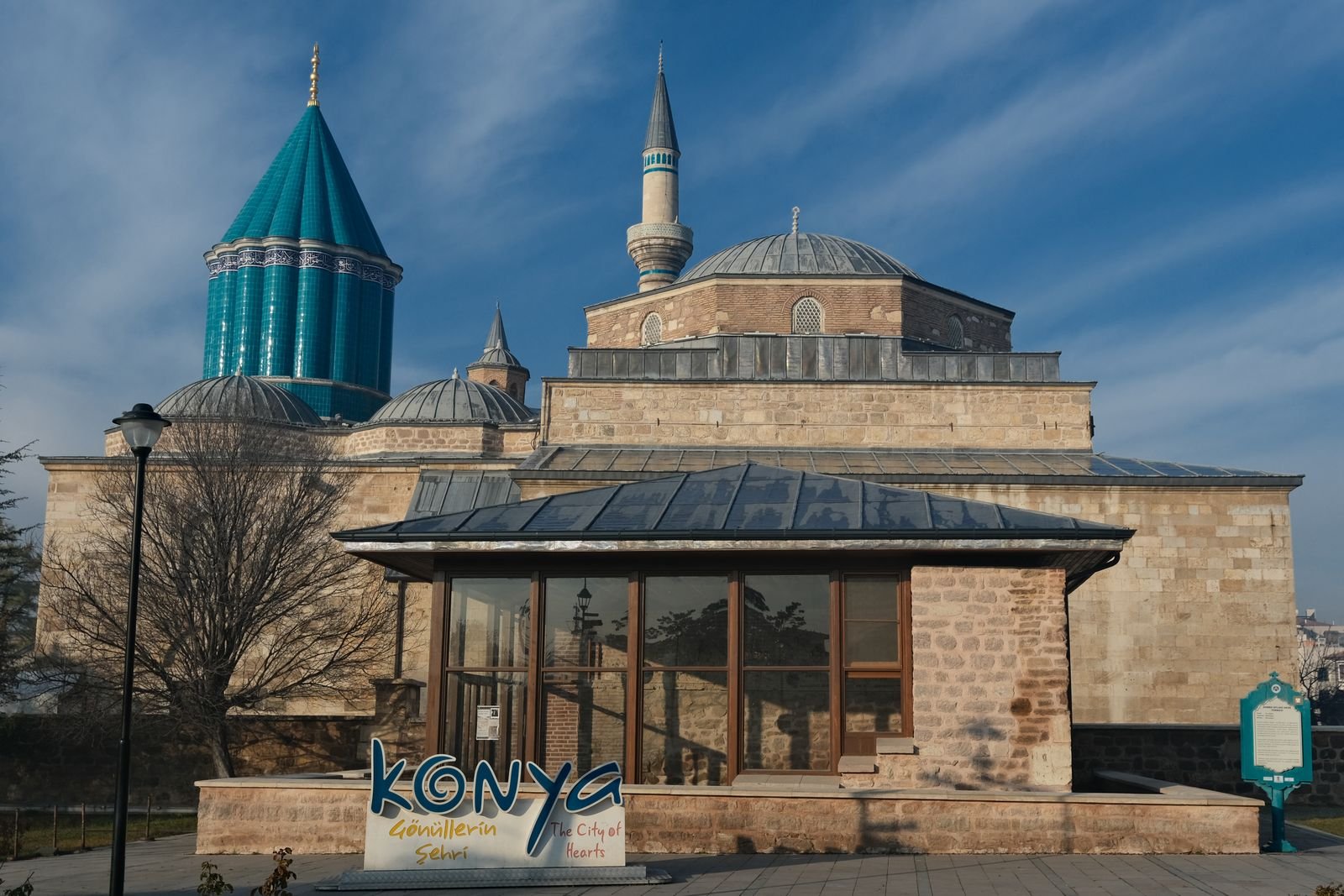
Rumi, known in Turkey as Mevlânâ (“our master”), is the most widely read of all the poets linked with Turkey, and the one most British visitors have already met in a quotation or a wedding reading. He wrote mainly in Persian, not Turkish, but he spent most of his life in Konya and is buried there under a turquoise dome.
This page covers his life, how his poetry works, what to read first in English and how to see his world on a trip. For the wider picture, see our guide to famous Turkish poets.
Life: from Balkh to Konya
Mevlânâ Celâleddîn-i Rûmî was born around 1207 in Balkh, in today’s northern Afghanistan. His father, the preacher and scholar Bahâeddin Veled, left the region with his family around 1218, as the Mongols advanced. After years of travel through Iran, Arabia and Anatolia, they settled in 1228 in Konya, then the capital of the Seljuk sultans of Rûm. The name “Rumi” simply means “from Rûm”, the old name for Anatolia.
Rumi followed his father as a teacher of religious law and was a respected scholar when, on 30 November 1244, he met a wandering dervish called Shams of Tabriz. The friendship turned his life upside down. Shams left Konya, came back, and disappeared for good in 1247; Britannica notes that he was probably murdered. Rumi’s grief and longing for Shams poured out as poetry, and he went on writing until his death on 17 December 1273.
Because he was born in Afghanistan, wrote in Persian and lived and died in Turkey, several countries claim his heritage, among them Afghanistan, Iran, Tajikistan and Turkey. The fair answer is that he belongs to all of them, and Konya is where his tomb is.
Poetic style and themes
Rumi’s great subject is love: the longing of the soul for God, often told through the love between friends. He uses everyday images, a reed flute cut from its reed bed, a moth and a candle, a guest house that receives every visitor, and he moves from comedy to prayer within a few lines. His lyric poems were often composed to music and movement, which is one root of the sema, the whirling ceremony.
The Masnavi is very different: a long poem of stories, jokes, sermons and commentary, which Rumi dictated to his disciple Hüsameddin Çelebi. It is less quotable than the lyrics but richer once you get into it.
Key works
- Mesnevî-i Ma’nevî (The Spiritual Couplets), the six-book teaching poem of nearly 26,000 couplets.
- Dîvân-ı Kebîr (The Great Collection), also called the Dîvân-e Shams (The Collected Poems of Shams), his lyric poetry.
- Fîhi Mâ Fîh (In It What Is in It), prose talks recorded by his circle.
Legacy: the Mevlevi order and the sema
After Rumi’s death his son Sultan Veled organised his followers into the Mevlevi order, which spread across the Ottoman world with lodges from Konya to Istanbul, Cairo and the Balkans. Its musical ceremony, the sema, is a form of prayer in which the dervishes turn to the sound of the ney (reed flute). Turkey closed all dervish lodges in 1925, and the Konya lodge reopened as a museum in 1927. UNESCO added the Mevlevi Sema Ceremony to its list of intangible cultural heritage in 2008.
In the English-speaking world Rumi has become a bestseller, mostly through loose modern versions that leave out the Islamic setting of his work. Reading a more faithful translation alongside them is worthwhile.
Where to find Rumi in Turkey
- Mevlana Museum, Konya. The former dervish lodge holds Rumi’s tomb, his father’s tomb, the old sema hall, musical instruments and manuscripts. Entry was free when we checked in November 2026. It is open every day from 09:00 to 17:00 (muze.gov.tr, checked 14 November 2026). It is a place of pilgrimage as well as a museum, so dress modestly, with shoulders and knees covered.
- Şeb-i Arûs, Konya. Rumi called his death his “wedding night”. The Ministry of Culture and Tourism’s programme for 2026 runs from 7 to 17 December at the Mevlana Cultural Centre, with a sema every evening. Tickets go through Biletinial and sell out fast; when we checked, new seats were released on Fridays.
- Weekly sema. Outside December the Mevlana Cultural Centre has held a free Saturday evening sema; check locally before you plan around it.
- Shams’s tomb. The small Şems-i Tebrizî mosque and tomb is a short walk from the museum.
There are no direct flights from the UK or Ireland to Konya. Most people fly to Istanbul and take the high-speed train; our getting to Konya page has the options, and things to do in Konya covers the rest of the city.

Read, watch and listen next
- Jawid Mojaddedi, The Masnavi (Oxford World’s Classics): a faithful verse translation, book by book.
- Reynold A. Nicholson: the older scholarly translation of the whole Masnavi, still the reference.
- Coleman Barks, The Essential Rumi: the popular version, closer to free adaptation than translation.
- Franklin D. Lewis, Rumi: Past and Present, East and West: the best biography in English.
- Listen: any recording of Mevlevi ney music, the sound you will hear at the sema.
Video: Who is Rumi? by TRT World (2021, English). Watch on YouTube.
Sources: Britannica on Rumi, the Ministry of Culture and Tourism’s Şeb-i Arûs 2026 page and UNESCO’s entry for the Mevlevi Sema Ceremony.
Frequently asked questions
Was Rumi Turkish?
He was born in Balkh, wrote mainly in Persian and lived most of his life in Konya, so Afghanistan, Iran, Tajikistan and Turkey all claim him. He is best described as a Persian-language poet who lived and is buried in Turkey.
Is the Mevlana Museum free?
Yes, entry was free when we checked in November 2026. Expect queues on weekends and during the December ceremonies.
Can I watch the whirling dervishes in Konya?
Yes. The big programme is Şeb-i Arûs in December, and the Mevlana Cultural Centre has held a weekly Saturday sema. It is a religious ceremony, so do not clap or use flash.
Related reading
- Famous Turkish poets: 12 names to know
- Yunus Emre
- Şeyh Galip and the Galata Mevlevi Lodge
- Bâkî, the “sultan of poets”
- Things to do in Konya
- Best time to visit Konya
- Customs and etiquette in Turkey
Prices and opening details checked in November 2026. Confirm on the official page before you go.